
Are Green Cleaning Products as Effective as Traditional Chemicals?
Updated: May 6
How to Choose Safer Cleaning Products Without Sacrificing Results
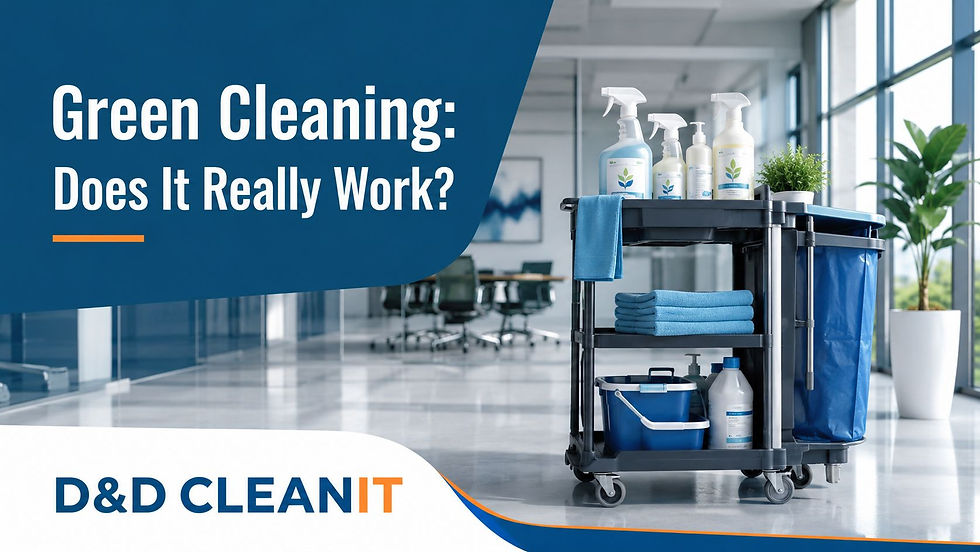
Many business owners and facility managers like the idea of green cleaning. They worry it won't actually clean the building.
That's a fair concern. For years, early "green" cleaning products had a reputation for being weaker than conventional ones, and that reputation stuck around long after the products improved.
Here's where things stand today: green cleaning products can be highly effective for routine commercial cleaning when you match the right product to the right task and use it correctly. They aren't always the right choice for every cleaning job, and they don't replace good process. But the idea that green automatically means weak hasn't been true for a long time.
This guide explains what green cleaning products actually are, where they work well in commercial buildings, where stronger or specialized products may still be needed, and what to ask before switching your facility over.
Key Takeaways
Modern green cleaning products can clean as well as conventional cleaners for most routine commercial tasks when used correctly.
Third-party programs like EPA Safer Choice and Green Seal require certified products to meet performance standards, not just safer ingredient lists.
"Green" is not a regulated label on its own. Certification is what helps reduce greenwashing risk.
Process matters as much as product. Dilution, dwell time, training, and equipment determine whether any product gets the job done.
Some cleaning tasks still call for stronger or specialized products, including registered disinfectants, heavy degreasers, and floor stripping chemistry.
A good cleaning company should be able to explain which products it uses, why, and when it would choose something else.
What Green Cleaning Products Actually Are
The term "green cleaning products" gets used loosely. In commercial cleaning, it generally means products designed to be safer for human health and the environment than conventional alternatives, while still cleaning effectively.
That can mean lower toxicity ingredients, reduced volatile organic compounds (VOCs), biodegradable formulas, fragrance-free or low-fragrance options, sustainable packaging, or some combination of those.
The catch is that anyone can put "green," "eco-friendly," or "natural" on a label. None of those words means the product was tested or reviewed by an outside organization. That's why third-party certification matters. Two of the most credible programs in the U.S. for commercial cleaning are EPA Safer Choice and Green Seal.
Green Cleaning vs. Traditional Cleaning Products
Traditional cleaning products often contain stronger chemistry: bleach-based disinfectants, ammonia, solvents, heavy degreasers, or higher-fragrance formulas. They can be very effective at what they're designed to do. They can also be harder on indoor air, more irritating to sensitive occupants, and more demanding in terms of safe handling and dilution.
Green cleaning products take a different approach. They're formulated to reduce the most concerning ingredients while still meeting cleaning performance benchmarks. The exact comparison depends on the product, the task, and how each one is used.
This isn't a story where one side is the villain. Conventional cleaners aren't all dangerous, and green cleaners aren't all gentle. The right comparison is task by task.
Green Cleaning Products vs. Traditional Cleaning Products
Factor | Green Cleaning Products | Traditional Cleaning Products | What Facility Managers Should Ask |
Routine cleaning | Generally effective for most surfaces and soils when used correctly | Generally effective; sometimes stronger than needed | Are we using the right strength for the task? |
Disinfection | Most green products are cleaners, not registered disinfectants | Includes EPA-registered disinfectants when needed | When does our facility actually need a disinfectant vs. a cleaner? |
Odor and fragrance | Often lower fragrance or fragrance-free options available | Can have strong residual odors | Are any occupants sensitive to scent? |
Indoor air | Typically lower VOC content; certified products are reviewed for VOCs | VOC content varies; can be high with solvents and aerosols | What ventilation do we have during and after cleaning? |
Heavy buildup | May need more dwell time or repeat application | Can cut through grease and buildup faster | Is this a routine or restoration-level task? |
Product documentation | Certified products disclose ingredients and pass performance review | SDS available; ingredient disclosure varies | Do we have the safety data sheet on file? |
Training and dilution | Same training requirements as any commercial product | Same training requirements; some require extra PPE | Are team members trained on dilution and dwell time? |
Are Green Cleaning Products Effective?
For most routine commercial cleaning, yes. The performance gap between green cleaners and conventional ones has narrowed significantly over the past 15 years, and certified products have to prove it.
Two examples of what that looks like in practice:
EPA Safer Choice requires that every product carrying the label "must pass category-specific performance standards" and "perform comparably to conventional products." That's a built-in performance requirement, not just a safer ingredient checklist.
Green Seal's GS-37 standard for industrial and institutional cleaning products goes further. It covers all-purpose, glass, bathroom, carpet, and biologically active cleaners intended for routine cleaning of offices, institutions, warehouses, and industrial facilities. To earn certification, products have to clean common soils effectively at the most dilute manufacturer-recommended level for routine cleaning, tested against established methods.
Effectiveness still depends on more than the bottle. The cleaning task, soil type, surface, dilution, contact time, dwell time, equipment, and training all play a role. A great green product used incorrectly will underperform. The right green product, used correctly, can get the job done.
Where Green Cleaning Products Often Work Well
In a typical commercial office or facility, certified green cleaners handle most routine work without trouble. Common examples:
Desks and workstations
Conference room tables and shared surfaces
Glass doors, partitions, and interior windows
Routine breakroom counters, tables, and exterior of appliances
Routine restroom maintenance: sinks, counters, mirrors, partitions
Hard floors with the right product matched to the surface
Dusting and damp wiping for general office surfaces
Vacuuming programs paired with low-irritant detail products
For a building with steady foot traffic and standard office use, that's a large share of the daily and weekly work. Pairing a routine cleaning program with certified products and a consistent process is a practical way to reduce harsh chemical use without giving up performance.
Dusting and damp wiping and vacuum cleaning are good examples. Most of the work is mechanical: the right cloth, the right vacuum, and consistent technique do most of the heavy lifting. The product is there to help, not to do the whole job.
Where Stronger or Specialized Products May Still Be Needed
Honesty matters here. Green cleaning isn't the right answer for every situation.
Some commercial cleaning tasks still call for stronger or specialized chemistry:
Heavy grease in commercial kitchens or food prep areas
Major buildup on neglected surfaces or after long gaps in service
Disinfection when there's a real reason to disinfect rather than clean (illness outbreaks, certain medical or food-contact surfaces, or specific compliance requirements). Disinfectants are EPA-registered pesticides, and most green-certified products don't make disinfecting claims
Floor stripping and refinishing chemistry, which is very different from routine floor cleaning
Odor or biohazard situations that need restoration-level products
Post-construction cleaning with heavy dust, residue, and material runoff
Some restroom issues like hard water buildup, urine salts, or grout staining that resist mild chemistry
A sensible approach is layered: use certified green products for routine work, and reserve stronger or specialized products for the specific tasks that need them. That keeps daily exposure lower while still giving the building what it actually requires.
Green Cleaning Doesn't Replace Good Process
This is the part most people skip. A bottle, by itself, doesn't clean a building.
Strong cleaning results come from process. A weak process produces weak results, no matter what's in the bottle. A strong process produces strong results across a wide range of products.
A good commercial cleaning process includes:
The correct product for the surface and soil
The right dilution, measured and consistent
Proper dwell time when the product needs it
Microfiber or other appropriate tools, not the same rag everywhere
Trained team members who understand why each step matters
Consistent routine cleaning instead of catch-up cleaning
Quality control checks and walkthroughs
Open communication with the facility manager about what's working and what isn't
When a building looks dirty after the cleaners leave, it's rarely because the products were too weak. Usually, it's because something in the process broke down: the dilution was off, surfaces weren't given enough dwell time, the wrong cloth got used on the wrong surface, or the same tasks kept getting missed.
Green cleaning works best when product, process, and schedule work together. Take any one of those out and the results suffer.
Product Labels and Certifications Worth Understanding
A few certifications carry real weight in commercial cleaning. Knowing what each one means helps you cut through the marketing.
EPA Safer Choice
Safer Choice is an EPA program that helps consumers, businesses, and purchasers find products that perform and contain ingredients safer for human health and the environment. Every intentionally added ingredient is reviewed by EPA scientists, and certified products must meet performance standards comparable to conventional products. The program also reviews packaging, pH, and VOC content. Safer Choice is voluntary, and the label is renewed through annual audits.
Green Seal GS-37
GS-37 is Green Seal's standard for industrial and institutional cleaning products. It covers all-purpose, glass, bathroom, carpet, and biologically active cleaners used for routine cleaning of offices, institutions, warehouses, and industrial facilities.
To meet GS-37, a product has to demonstrate cleaning performance against established test methods, limit VOC content, restrict harmful ingredients (including specific carcinogens, reproductive toxicants, asthmagens, and ozone-depleting compounds), set pH limits, and meet packaging requirements. Performance and safer chemistry both have to clear the bar.
Green Seal GS-42
GS-42 is a different kind of standard. Instead of certifying a product, it sets criteria for green cleaning services. It addresses procedures, training, chemical handling, equipment, communication, and quality control. It's a useful reminder that green cleaning is more than what's in the bottle.
What Certifications Don't Do
Certification helps reduce greenwashing risk, but it doesn't mean every certified product is the right choice for every task. Some green-certified products are general-purpose cleaners, not disinfectants. Some are designed for specific surfaces. Reading the label, understanding the use directions, and matching the product to the job still matter.
Indoor Air and Respiratory Concerns
Cleaning products affect indoor air. EPA notes that concentrations of many VOCs are consistently higher indoors than outdoors, sometimes by a factor of two to five, and that cleaning, disinfecting, and degreasing products are common contributors.
That doesn't mean every cleaning product is a problem. It does mean product choice, ventilation, and timing matter, especially in offices with sensitive occupants, schools, medical offices, or buildings with limited fresh air exchange.
Practical steps that help:
Choose products with lower VOC content where possible
Limit aerosols and heavy fragrance products in occupied spaces
Increase ventilation during and after cleaning when feasible
Schedule stronger chemistry, like floor stripping, for off-hours
Communicate with occupants when scent-sensitive areas need adjustments
This is also where a fragrance-free or low-fragrance approach can make a real difference. Even some products marketed as natural include citrus or pine-based compounds that can react with indoor ozone to form secondary pollutants. Lower-fragrance certified products may help reduce that concern, especially when paired with good ventilation and proper product use.
If your building has occupants with allergies, asthma, or chemical sensitivities, this is worth a direct conversation with your cleaning company.
How to Choose Green Cleaning Products for a Commercial Facility
A practical decision framework helps cut through the marketing and get to a real answer for your building.
Ask these questions for each cleaning task:
What surface is being cleaned? Glass, carpet, hard floor, breakroom counter, restroom fixture, and high-touch hardware all behave differently.
What soil or residue is present? Dust, fingerprints, food, grease, body soil, and biological residue each call for different chemistry.
Is disinfection actually required, or is cleaning enough? Most office surfaces are cleaning tasks, not disinfection tasks.
Are occupants sensitive to fragrance or chemicals? This shifts product selection in scent-sensitive areas.
Is there a sustainability policy or tenant requirement? Some buildings, especially LEED-rated or healthcare-adjacent properties, have purchasing rules.
Does the product have third-party certification? Safer Choice, Green Seal, or other recognized certifications reduce greenwashing risk.
Does the cleaning company train team members on proper use? A great product without trained use isn't going to deliver.
5 Steps to Make Green Cleaning Work in a Commercial Facility
Identify the cleaning task. Be specific. "Restroom cleaning" is not one task; it's several.
Match the product to the surface and soil. The right tool for the right job, every time.
Confirm certification or product documentation. Look for Safer Choice or Green Seal where it makes sense, and check the safety data sheet.
Train team members on proper use. Dilution, dwell time, equipment, and PPE.
Review results and adjust the plan. What's working, what isn't, and what should change next quarter.
What to Ask a Cleaning Company Before Switching to Green Cleaning
If you're evaluating cleaning companies or thinking about shifting your current program toward green cleaning, these are practical questions to ask. Strong answers signal a company that thinks carefully about products, processes, and communication. Vague answers are a flag.
✓ Which green products do you use, and why those?
✓ Are any of the products you use EPA Safer Choice, Green Seal, or otherwise third-party certified?
✓ When would you not use a green product? What's the call there?
✓ How do you handle disinfecting separately from routine cleaning?
✓ How are team members trained on dilution, dwell time, and safety data sheets?
✓ Can you adjust products for scent-sensitive areas or specific occupants?
✓ How will you communicate product changes to our team and occupants?
✓ What does your quality control process look like for verifying that products are being used correctly?
A company that can answer these clearly is doing the work. A company that can't probably isn't.
Most Relevant Facts and Figures
A few useful reference points from credible sources:
EPA Safer Choice requires every certified product to "pass category-specific performance standards" and "perform comparably to conventional products." Performance is a built-in requirement of the certification, not an afterthought.
Green Seal GS-37 covers industrial and institutional general-purpose, glass, bathroom, carpet, and biologically active cleaners used for routine cleaning in offices, institutions, warehouses, and industrial facilities. Certified products must demonstrate cleaning efficacy at the manufacturer's recommended dilution for routine cleaning.
Indoor VOC concentrations are consistently higher indoors than outdoors, often by two to five times, with cleaning, disinfecting, and degreasing products among the documented sources.
Safer Choice product review also restricts VOC content to help limit indoor air pollution and respiratory concerns, alongside ingredient and performance review.
These facts support the same practical point: certified green cleaning products are reviewed for both safer chemistry and cleaning performance, which is why they can hold their own for most routine commercial cleaning.
How D&D CleanIt Can Help
D&D CleanIt provides commercial cleaning services for offices, multi-tenant buildings, medical offices, schools, and other commercial properties across the Philadelphia suburbs, including Montgomery, Chester, Delaware, and Bucks Counties.
Green cleaning is not a one-size-fits-all program. It works best when it is built into a cleaning plan that fits your building, your occupants, and your goals. For some facilities, that means certified green products across most routine work, with stronger chemistry held in reserve for specific tasks. For others, it means a more limited shift focused on scent-sensitive areas or specific tenant requirements.
We start with a walkthrough to learn how your building is used, what the current cleaning program covers, and where the gaps are. From there, we build a plan that pairs the right products with the right process across routine cleaning, restroom cleaning, breakroom and lunchroom cleaning, and the other services your facility needs.
We use trained in-house team members, not subcontractors. That matters here because product choice only works if the people using the products are trained on dilution, dwell time, and the basics of why each product was chosen. Our leadership team checks the work and stays involved.
If green cleaning is something you're thinking about, we're happy to walk through your building, look at what you're using now, and talk through what would actually make sense.
Frequently Asked Questions
Are green cleaning products as effective as traditional chemicals?
For routine commercial cleaning, certified green cleaning products can perform comparably to conventional products. Programs like EPA Safer Choice and Green Seal both require certified products to meet performance standards, not just ingredient criteria. Effectiveness still depends on matching the right product to the task, using correct dilution and dwell time, and pairing the product with a consistent cleaning process and trained team members.
Can green cleaning products disinfect surfaces?
Most green cleaning products are cleaners, not disinfectants. Disinfectants are EPA-registered pesticides with specific kill claims, and they're regulated under a different program. Some green-certified disinfecting products do exist, but most green-labeled cleaners are designed for general cleaning rather than killing pathogens. If your facility needs disinfection for specific surfaces or compliance reasons, that should be handled separately from routine cleaning.
What does EPA Safer Choice mean?
EPA Safer Choice is a voluntary certification program that helps buyers find cleaning products with safer chemical ingredients and verified performance. Every intentionally added ingredient is reviewed by EPA scientists, and certified products must meet category-specific performance standards comparable to conventional products. The program also reviews pH, VOC content, and packaging. Products are audited annually to keep the label.
What does Green Seal mean for cleaning products?
Green Seal is a nonprofit that develops science-based environmental standards. For commercial cleaning products, the relevant standard is GS-37, which covers industrial and institutional cleaners. To earn certification, products must demonstrate effective cleaning at the manufacturer's recommended dilution, limit VOC content, restrict harmful ingredients, meet pH limits, and follow packaging requirements. GS-42 is a separate standard that covers green cleaning services rather than products.
How can a facility manager decide whether green cleaning is right for an office?
Start by listing your routine cleaning tasks and identifying which ones could be handled by certified green products. For most offices, that includes desks, glass, common surfaces, breakrooms, and routine restroom maintenance. Reserve stronger or specialized chemistry for specific tasks like disinfection, heavy buildup, or floor stripping. Then ask your cleaning company about training, certifications, and how they communicate product changes to your team.
Talk With Us About Green Cleaning for Your Building
If you're a facility manager, office manager, property manager, or business owner thinking about a greener cleaning program, we're happy to walk through your building and talk through the options. There's no pressure and no canned pitch. Just a practical conversation about what your facility actually needs.
D&D CleanIt serves commercial properties across Montgomery, Chester, Delaware, and Bucks Counties.
Give us a call at 1-610-539-5212 or visit our contact page to request a walkthrough or quote.
Comments